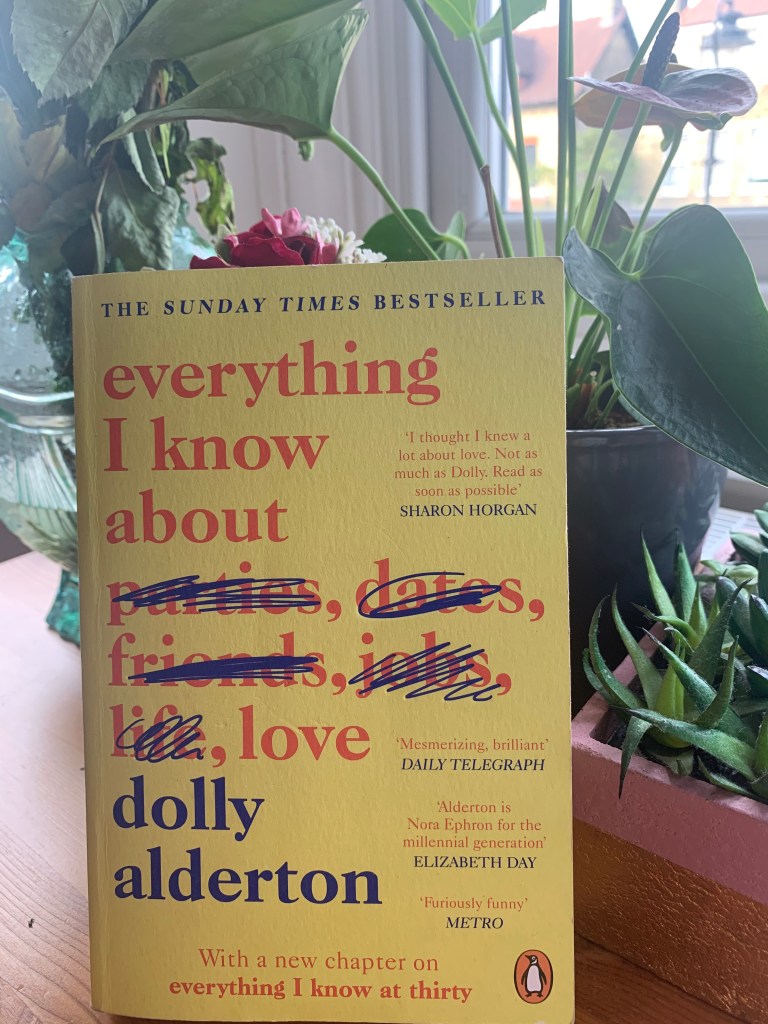
everything I know about love by Dolly Alderton

Since my last few blogs and reads have been rather dark, I thought I’d lighten the mood with this lovely memoir by writer, podcaster and journalist Dolly Alderton. This was lent to me by my best friend, Morwenna, who was lent it from one of her best friends. I’d also seen it in Urban Outfitters and then thought I’d better give it a read as an attempt to be ‘edgy’. I’m not one to read modern, romance books yet this one was worth the read.

If you are in a relationship or not. Whatever gender you identify as. It’s a book for you if you’re up for a change and looking for an insight into daily life. There were many relatable moments as Alderton spans from her primary school love life, the convoluted 20s and up until her 30s. With nostalgic references to MSN, disasters at house parties, memorable dates and her interesting experiences gallivanting around Camden Town, much can be appreciated. Although, based on her rather fortunate upbringing, aspects of her life could be taken with a pinch of salt-with references to her private school upbringing etc.

For me, the highlight of the book is the copious amounts of recipes, shopping lists, relatable lists, placed in between the anecdotes of her romantic experiences. Alderton draws attention to the strange decades of the 20s and 30s where some friends are getting married, children and then contrasted with some being single, which can be reassuring at any age. Her honesty, particularly as a woman, regarding her openness to friends-with benefits relationships, casual sex and drinking/drugs, which is admirable for her to share so publicly and normalises life experiences.

It’s light, conversational and easy to read, like having a conversation life with a friend, who then shows you their notes section of their phone!
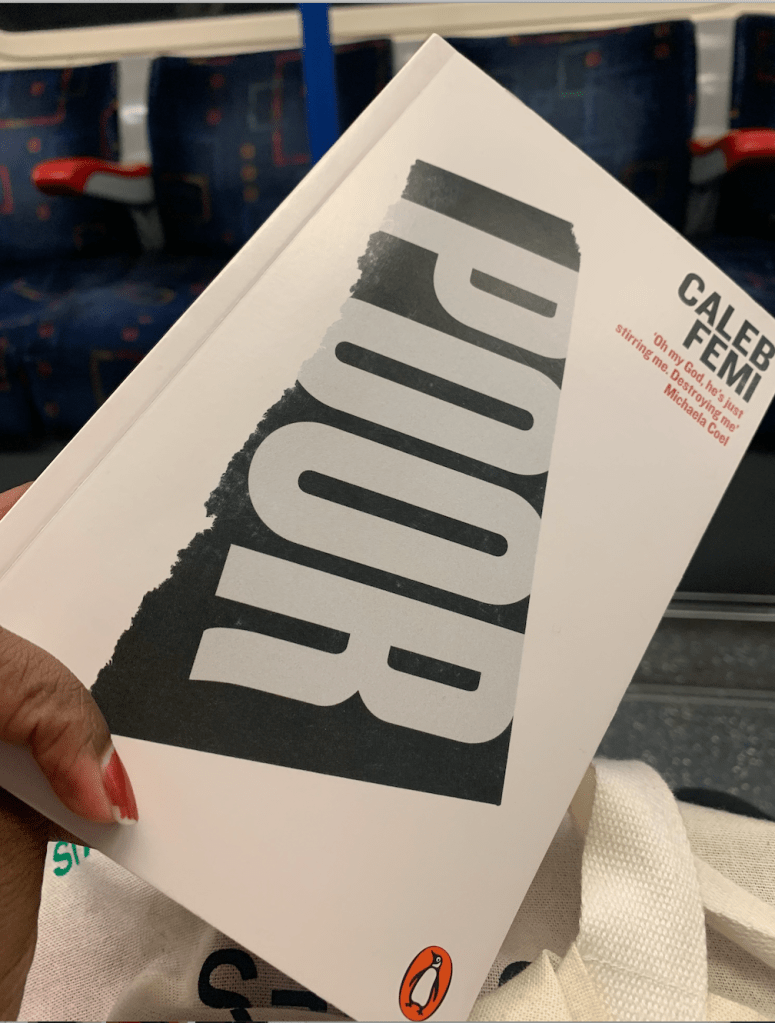
Poor by Caleb Femi

Poor by Caleb Femi in true London tube fashion

A stunning, remarkable combination of original poetry, photography and extracts regarding the genuine lives of the poor, black youth in Peckham Estate (South London, UK). Femi truly captures the roughness and reality of modern London; whilst delicately exposing the social inequalities which have amounted, as a result of hapless social housing estates.

I’d come across this book after my obsession with ‘Don’t Hate the Playaz’ on ITV hub (a riveting talkshow/gameshow with guests from the RNB music industry) hosted by Rizzle Kick’s Jordan Stephens, who posted this book on his instagram. As a speaker for toxic masculinity, representing black positive culture and of course, the music industry, I immediately ordered the book based on his interest. Wow, I was not disappointed! As you may have realised, I adore classic novels and literature, therefore was utterly enlightened to be transported into the vivid world of poetry, photography and unique narratives.

Each page or two speaks volumes. You can feel Femi’s focus, passion and energy to meticulously select words throughout. My personal favourite page consists of a playscript type structure, in which a Council Estate Designer denotes his decision to build with concrete in one line, immediately beneath this idea is juxtaposed with a council estate inhabitant who describes the loneliness and suffocating feeling of being surrounded by concrete. It’s astonishing how those opposing conversations mirror social inequality. Here, we have this wealthy Conservative architect from the 1960s wanting a quick-fix for the post-war housing crisis, right next to the twenty-first century innocent boy, struggling to find a way out of the poverty cycle. That was only one example of Femi’s intricate work that makes up this book.

There was also a personal aspect to this novel. I grew up in a housing association London flat, grew up in poverty and as a black young woman, have experienced a plethora of hardships. However, I had a wonderful childhood full of diversity, morals and love. Femi also captures the beauty in humanity which comes with poverty, such as the iconic, cultural home cooked meals and infamous South-London accent ‘bruv, money-up’ which takes me back to my beloved inner-London comprehensive school days! I could see and relate to aspects of these stories, without being patronising or judgemental.

Femi has given the South-London youth a voice through a variety of mediums within this book. I can’t persuade you enough to pick up a copy, it’s incredible.

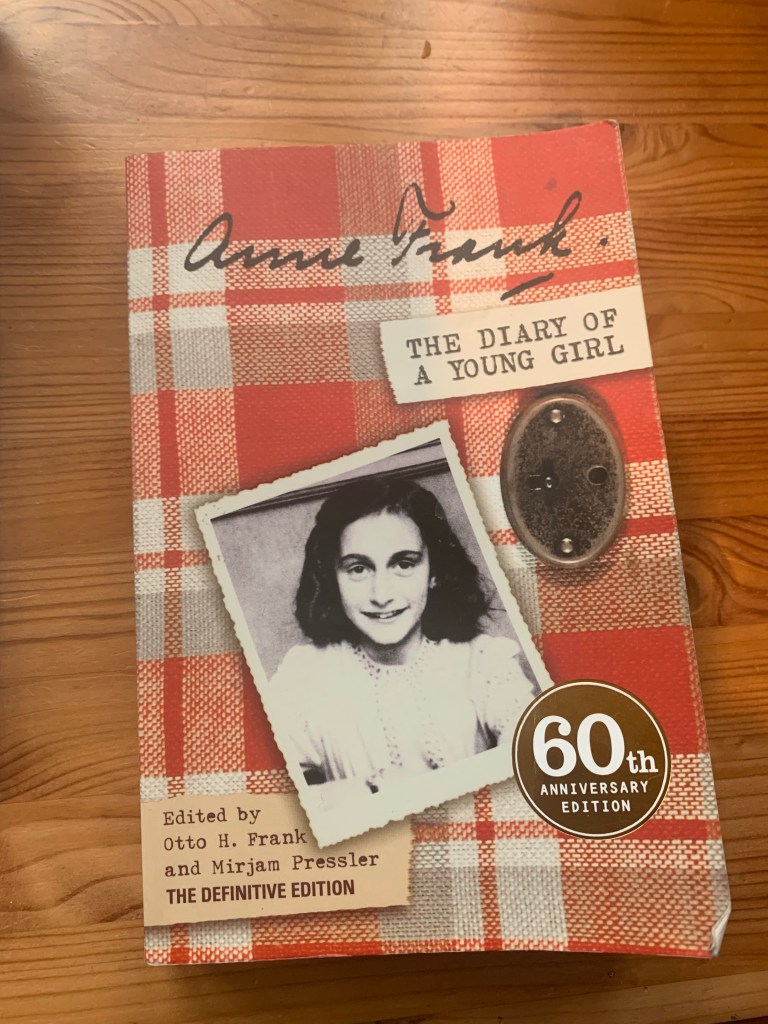
Anne Frank: The Diary of a Young Girl

60th anniversary

Anne Frank’s iconic diary speaks wonders about humanity. In the most dire of circumstances, she found comfort in writing, expressing her inner emotions and opinions about a plethora of subjects during her time in hiding in a secret Annexe in Amsterdam during World War Two.

I am really struggling to write this review since the subject is utterly devastating. I was always too afraid to read the diary based on the horrific aftermath of their lives. However, after visiting the Anne Frank museum in Amsterdam my view changed and instead I saw the purpose of her diary. Rather than dwelling on horrors of war and the injustice of humankind, Anne Frank discusses how the eight members survived, their daily routines, the news, hobbies, sexuality and romance. As she grows, so does her criticality as a writer and her opinions and views change too.

What strikes me most about her diary is her eloquence as a young writer-from aged 13 to 15- with excellent vocabulary and her opinions on life at such a tender age. Anne Frank wished to be a writer and hoped her writing (she edited her diary and wrote a story about the Annexe) would be read by many, which is the sole purpose anyone should fulfil her wishes.

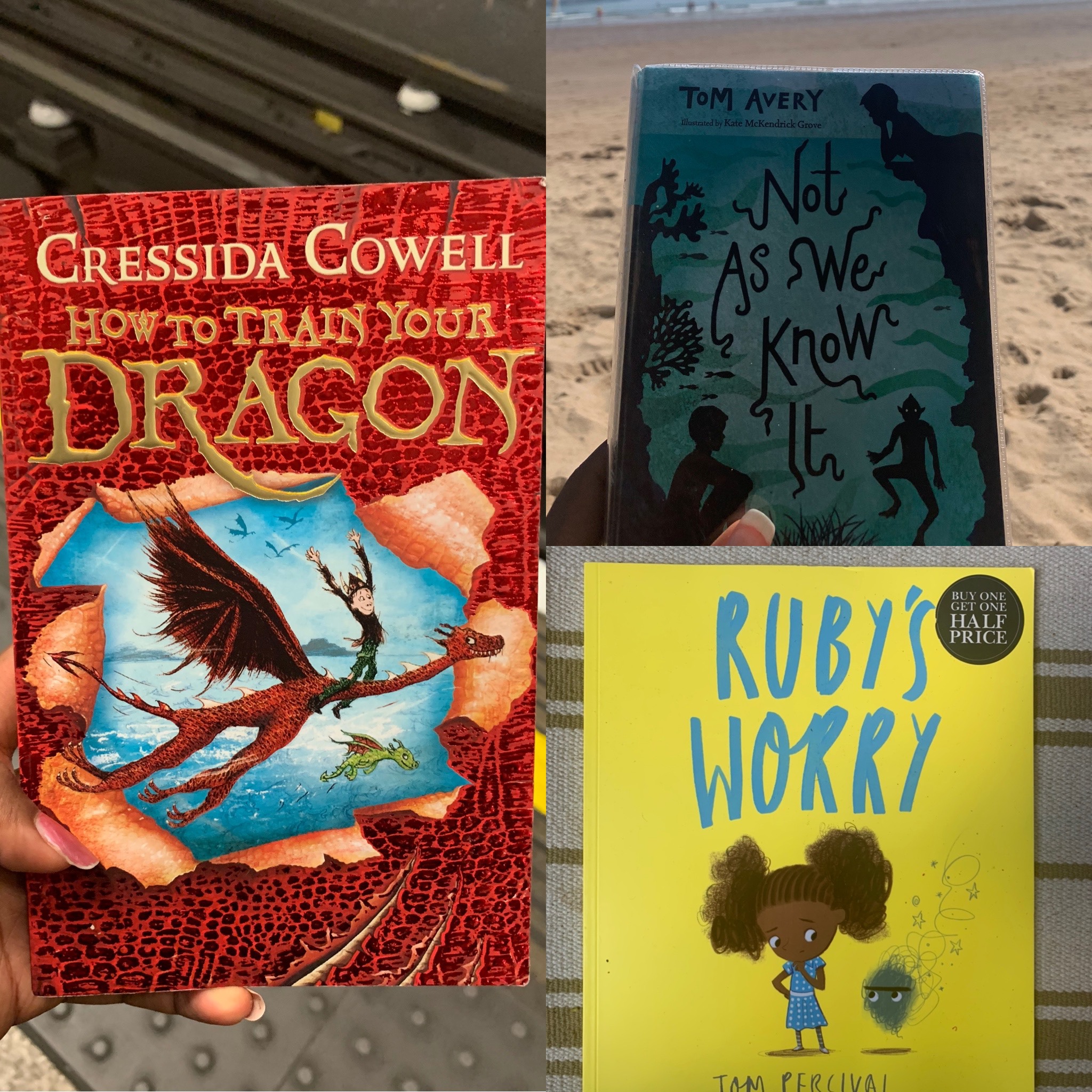
A bundle of children’s fiction

Yes, it’s been a very long while! I underestimated the all consuming nature of teaching especially as an NQT. However, as a year four teacher, I have had to read a range of wonderful children’s fiction. Here are my faves so far…

How to Train Your Dragon. Iwas pleasantly surprised to find out that the book differs to the movie! So to my teacher readers, this is a great one for predictions and as a hook, particularly for boys, to find their love for reading. My class were very eager for it to be our class text based on some prior knowledge and the fantasy genre. Another positive is the authors choice of language, especially for children’s fiction! Stunning, high-level vocabulary fills the pages and she does repeat them which is excellent as a learning tool. Although, the characters name bother me aka “Snotlout” and “Hiccup” as well as heavy speech. Cressida Cowell tells the tale of “Hiccup Haddock Horrendous the Third” (awful, I tell you!) the son of the chief, to remain part of the Viking tribe, he and his generation must capture a dragon and train a dragon otherwise they will be exiled. With themes of heroism and unlikely friendships.

Ruby’s Worry by Tom Perceval. During a staycation visit to Leeds with my old housemate and fellow teacher, we enjoyed a trip to Waterstones where he recommended this picture book. With stunning illustrations amongst carefully selected colour choices, Ruby’s Worry was a perfect stimulus for my year fours kids regarding worries and emotions. Stunning pages depict our black protagonist (so instantly relatable for child me!) who discovers a worry which she attempts to ignore, until this vibrant worry cannot be ignored any further…

Not as we Know It by Tom Avery I’m not sure how I feel about this one! I was hooked by the Portland coastal setting and mysterious creature quest. However, the creature isn’t the main focus of the story, instead it’s the protagonist’s dying twin. I commend the author for writing about children often forgotten in children’s fiction, although the quest could have been further developed.

This was just a bit about each children’s book, which I recommend for any age to enjoy!

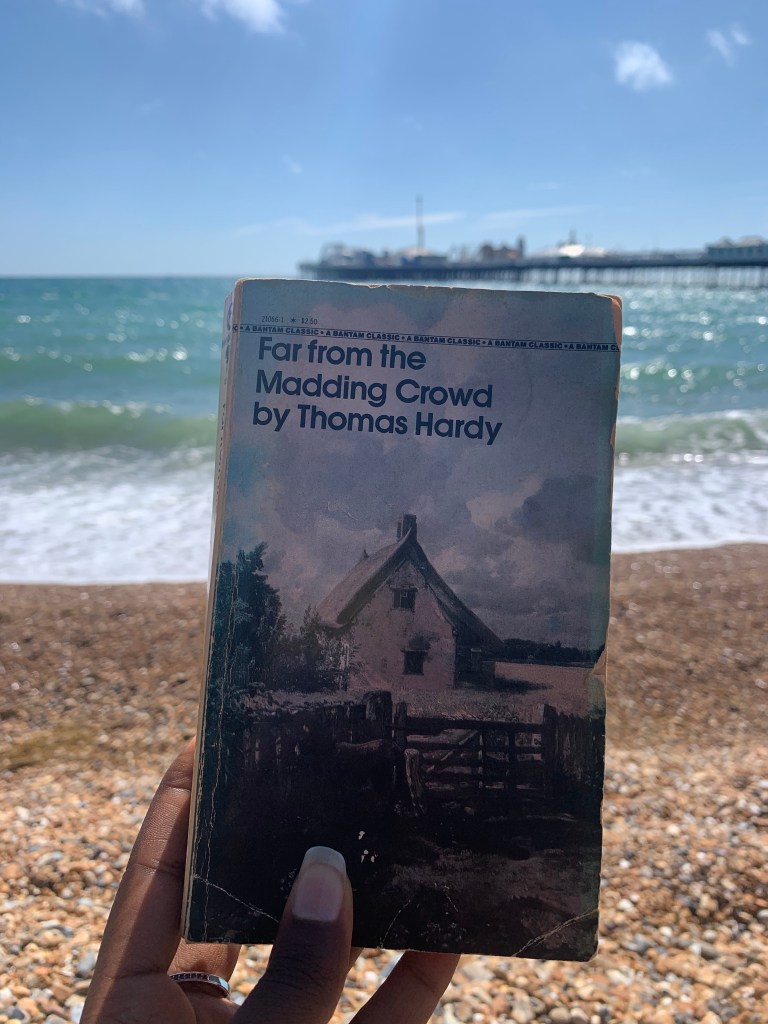
Far From the MaddingCrowd by Thomas Hardy (no, not the pretty actor)

Another one of my Brighton charity shop finds… a book classic in excellent condition, with that iconic old book smell (similar to that of vanilla, in my opinion!). As expected for a Victorian classic, the book was initially released as chapters for a national magazine, however was Thomas Hardy’a fourth novel. I love that about old books as each chapter ends on a gripping cliff hanger!

‘Far from the Madding Crowd’ is a love story. Following the countryside life of strikingly stunning “Bathsheba” and three eligible bachelors she meets throughout her lifetime. Hardy eloquently describes each of her contrasting suitors- the wholesome farmer “Gabriel Oak“, lonely yet sweet “William Boldwood” and dashing soldier “Sergeant Troy”- and their individual attempts to wed the independent Bathsheba.

I was taken aback by the modern personality of Bathsheba, since she was a seemingly modern woman. A female farm owner who wishes to be single for as long as possible. I love the way he describes her sassy mannerisms and pursed lips as a contrast to the stereotypical ladies at the time. There is also a clever contrast between Bathsheba and her contented, passive maid.

Hardy describes everything in minute detail. This was initially impressive, however it did mean that the scandalous dramas finally unfolded at a good 300 pages in (the book is around 400 pages). I also found the literature rather difficult to follow, when I’m usually pretty good to access classical literature. I had to reread pages and ensure I was focussed when I took the time to read (hence the beach book pics), yet it is worth it if you are really into classics and romance. There is also a film made recently which I look forward to watching just to see how it really did pan out!

Movie quote- “What do you want? You want the moon? Just give me a lasso and I’ll get it for ya!” George, It’s a Wonderful Life. Now I’m not usually one for romance, unlike my younger brother, yet I adore this quote. George delivers the line so nonchalantly to show that love is as easy as breathing and that with love, you can accomplish anything for anyone.

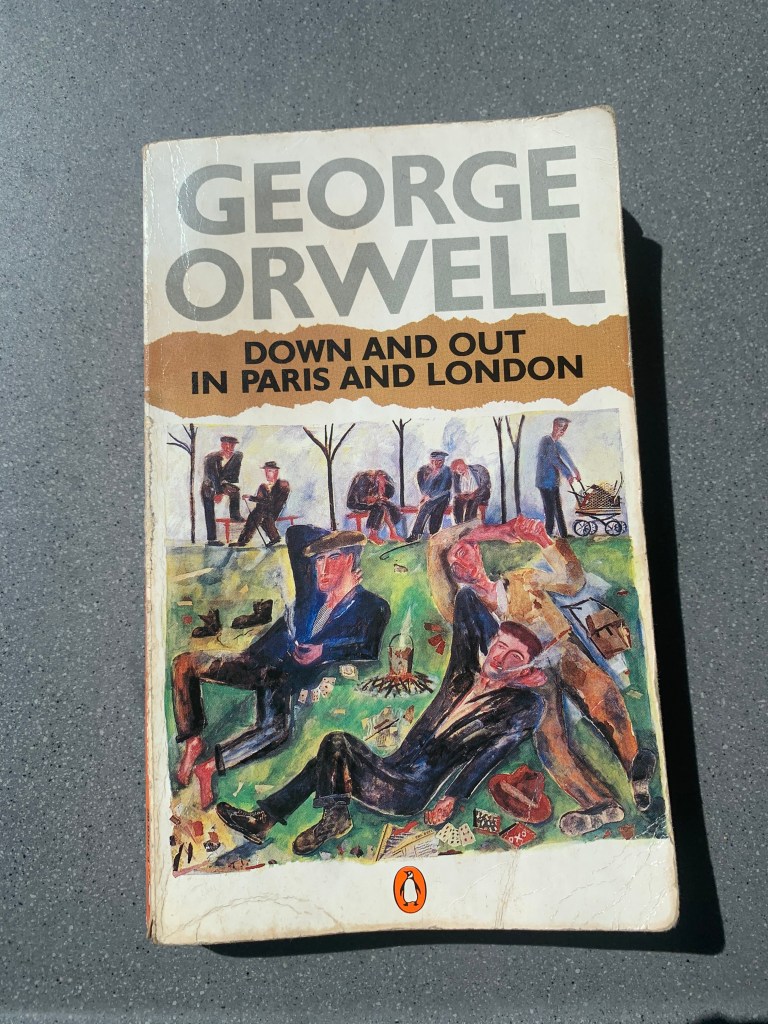
Down and Out in Paris and London by George Orwell

After a charity shop book haul, I was eager to begin this one due to having ultimate faith in trusted author, George Orwell (aka Eric Blair). More famously known for his final book “Nineteen Eighty-four” written before he passed away of TB, “Down and Out in Paris and London” (DOPL) was in fact his first full book. With a strong purpose in which to provide an insight into the world of poverty and unemployment during the early 20th Century in two prosperous cities- Paris and London.

Aspects of the book were based on Orwell’s observations during his own experiences of being “down and out” in both cities. Despite his affluent upbringing and prestigious education at Eton College, Orwell did not wish to conform to his peers and progress into Oxbridge. Instead, he served in the army and then decided to live in Paris as a writer. This did not bode well and he, like many other educated people as vividly described in the book, became a “plongeur”, essentially a dish washer in ostentatious Parisian hotels. The first half of the book explicitly comments on the experiences of an Englishman becoming a plongeur in Paris, with extreme detail on how he survives on hardly any francs, wine and stale bread. Meeting interesting characters along the way, including his Russian friend “Boris” who he ends up lodging with in a room covered with bugs. Orwell does not shy away from the appalling conditions of those working eighteen hours a day in a sweltering underground kitchen, earning just enough for a single meal before repeating their monotonous day once again. He likens the life of a plongeur to a slave, commenting on the absurdity of the wealthy who dine in such hotels, who’s incredulous demands fuel such maltreatment of staff.

The second half comments on the vast unemployment in London which could possibly be the cause of the “tramp culture” in London. In comparison to the educated scholars who became lost to the Parisian system, the protagonist meets uneducated, hapless men in London who seem to have given up and instead plan their days around collecting cigarette ends and succumb to praying in a church for vile tea and a slice of toast. Again, Orwell intensely describes the odours of such characters and their experiences in numerous homeless shelters, known as “spikes”. He comments on the way such places strip men and women of any dignity they may have left, however aptly describes the unfortunate as victims to our society.

Nearly one hundred years on and the same social issues are prevalent today. A book written for the middle and upper classes to empathise and highlight the real lives of those among them can be applied today. Another social-economic read similar to “The Five” (see first post) however from a male narrative with a mixture of fiction and non-fiction. I must admit, it took me a little while to read as I had to keep rereading the page if I got lost! So was a tad difficult to follow, however once I allocated the time to read and remained focused it could be done well!

Film quote-

“Roads? Where we’re going, we don’t need roads!” Doc Brown, Back to the Future.
My favourite film ever! I hope that the future will be rid of stark social inequalities, that society would have listened to one another to build a safe, prosperous and equal life for all. I hope that in 30 years the world will look entirely different..for the best.

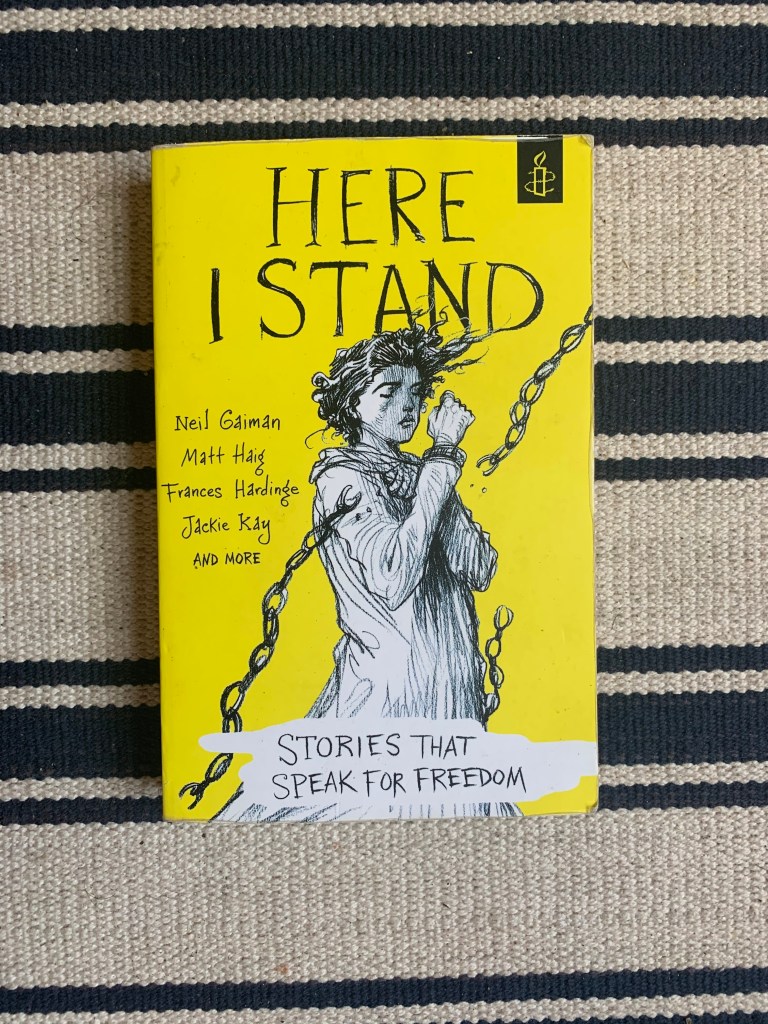
Here I Stand edited by Amnesty International

*trigger warning* this book and review contains potentially distressing material

Amnesty International collated this insightful collection of short stories and poems to highlight the need to continue fighting for our rights, including in our own country. With a focus on experiences in the UK and USA, Amnesty illustrates the harsh realities that young people face in our contemporary society including- statutory rape, Female Genital Mutilation (FGM), terrorism, bullying, suicide, homophobic experiences, gang culture, women’s rights and other forms of abuse.

Each story is completely unique and gripping. From a graphic novel format to poetry, inspiring writers tell controversial and sensitive stories in a thought provoking way. The authors are well-known for their background in celebrating diversity and spreading awareness. In around three hundred pages, you are engrossed in the lives of young adults and young people, often from forgotten groups and those marginalised by society, such as those in the prison system or the quiet kids in school often ignored. Each author summarises the meaning behind their choice of story, either from a recent news event or from personal experiences which add to the considerate nature of the book. As in no way is it patronising, instead it guides and invites the reader to reflect.

Yes, it’s a heavy read, however it is written for young readers so is very accessible. I’d come across it from a friend of mine recommending it and I’m so grateful she did otherwise I probably would have thought it was too sad to read. But I implore you to give it a go and all proceeds go to Amnesty International who work to continue the protection of human rights all over the globe.

”You are strong and wise and I am very proud of you”- Obi Wan Kenobi, Star Wars: Revenge of Sith. My brother’s fave Star Wars film, yet was a rather fitting quote based on this sensitive book. For anyone experiencing any form of abuse or injustice.

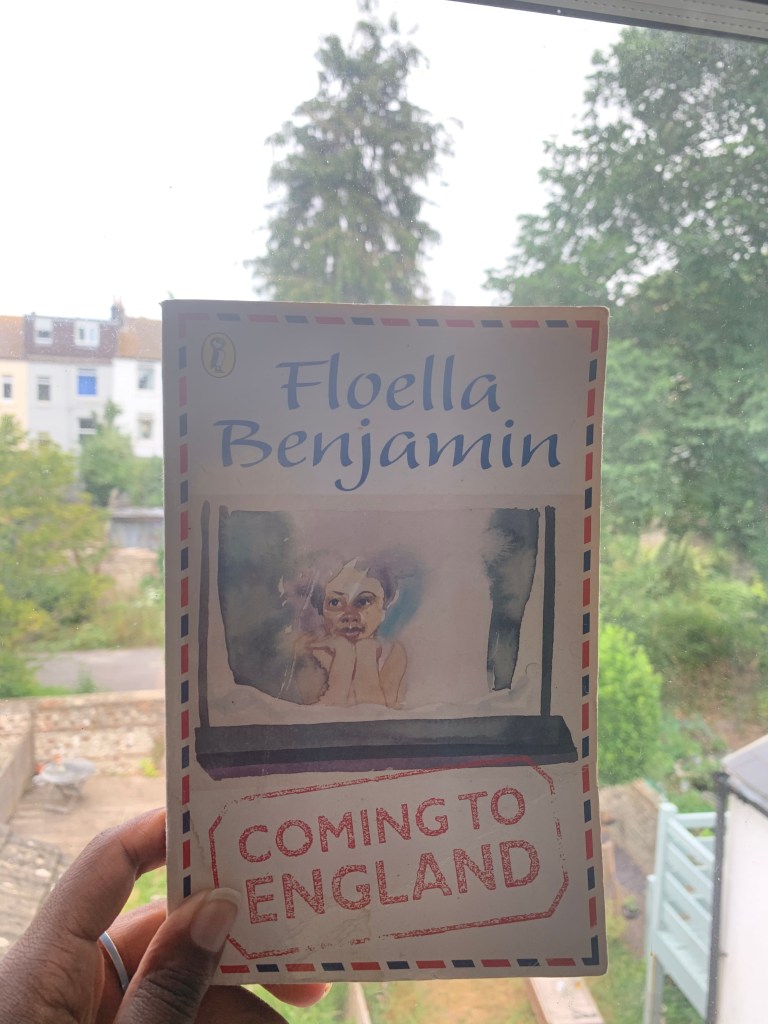
Coming to England by Floella Benjamin

This one is for the proactive teachers who take ownership over introducing their class to books by diverse authors. Or to those wanting to learn about Black British History in an afternoon. In 2017 only 5.58% of children’s book authors were written by people of colour (Booktrust.org). How do schools across the UK expect children to be aware of their own culture, heritage and backgrounds without books with characters or role-models which they can identify with? In light of the powerful Black Lives Matter Movement, I wanted to share this short, classic memoir, by Trinidadian born presenter and actress Floella Benjamin.

This was the key text of the term in my second year uni school placement in Worthing. Despite the coastal location, with some BAME students, teachers admirably decided to make the Empire Windrush their term topic as the government scandal resonated in the news. Staff here ensured ALL children learnt about the generation of Caribbean people which took the opportunity to live and work in the UK, as the government sought to manage the aftermath of WW2. Floella Benjamin describes the trials, tribulations and joys in ‘Coming to England’ in 1960.

She delicately describes the subtle forms of colonialism and imperialism inherent in her childhood in Trinidad and her struggle as a new child arriving in England. Whilst also illuminating the vibrancy of the Caribbean through her accurate descriptions of Caribbean life, including the unique food and lively music. Floella Benjamin celebrates the ‘traditional’ British culture and her experiences trying new British staples like fish and chips, which many children who join the UK today can also relate to.

I adore this book due to the author’s ability to capture the stories my own grandparents described to me and to hear about the similar childhood experiences my parents’ generation underwent. It has a perfect balance of harsh reality and success stories from a child’s perspective, which is so relevant in our society today.

Movie Quote: ‘Quite frankly my dear, I just don’t give a damn’ Rhett Butler- Gone with the Wind.

Again, another recent scandal and film removed over ‘racism’. However, this whole film depicts the reality of life during and after the American Civil War which sadly meant the use of slaves. However, the aftermath of the American Civil Warm sparked more white Americans to empathise with the black community after experiencing similar hardship, thus contributing to the anti-slavery movement. As such, this film is a source of history which deserves to be played and ignorant individuals should do their own research.

A Clockwork Orange by Anthony Burgess

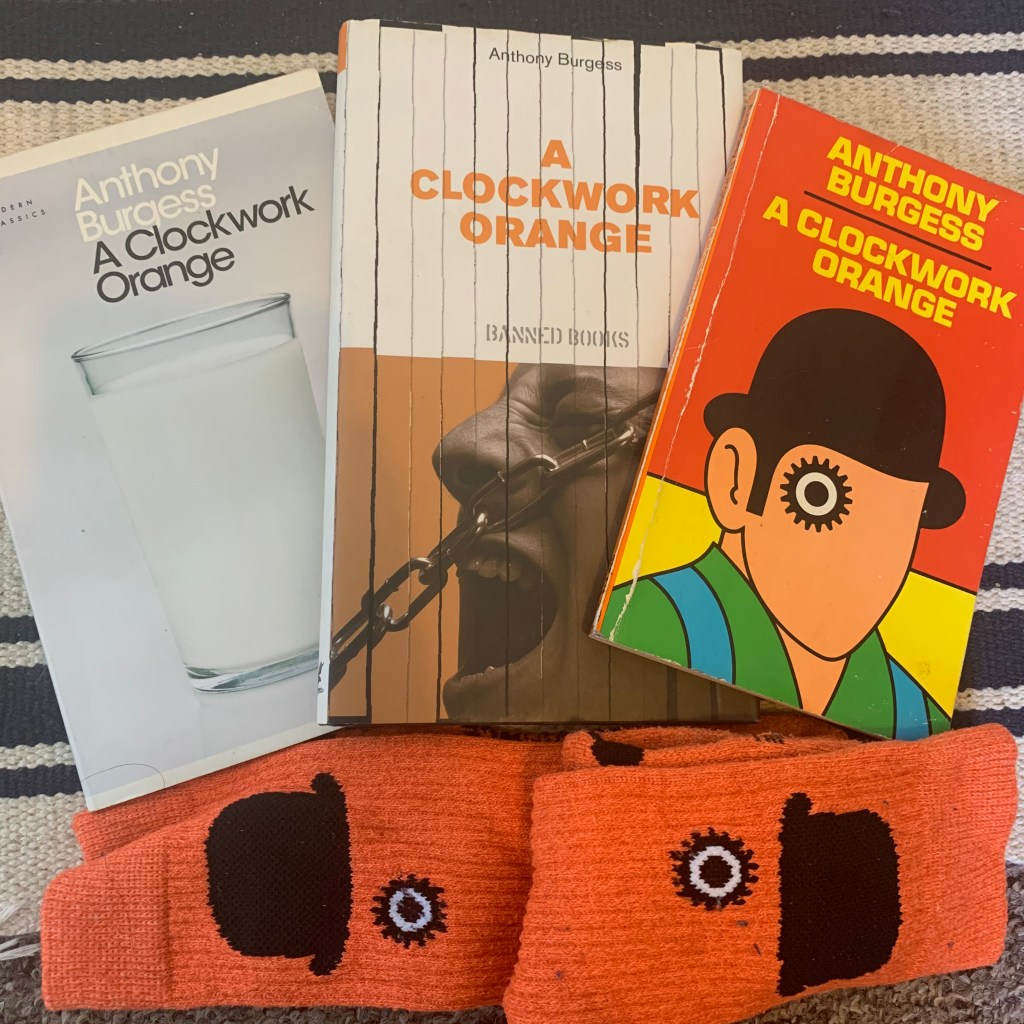
Not a franchise…just have three copies as one doesn’t do it justice

So ‘A Clockwork Orange’ (ACO) is my all-time favourite novel, ever. I have so much love for it, every time I come across a copy somewhere I must have it (back story to each book in final paragraph)! That is also the case for ACO merchandise… judging by my iconic, cult classic Stanley Kubrick ACO film socks and patch permanently attached to my rucksack.

Now enough about my addiction…and let’s crack on with the book review!

This cult classic, previously banned in the US novel was written by Anthony Burgess in 1962. After being told he had very few months to live upon discovery of a brain tumour in 1959, Burgess was determined to write full-time and proved doctors wrong by writing a book every year until his death in 1993. As a graduate of English Language and Literature, he was enthralled by language and used his linguist knowledge to masterfully create his own language for the book, known as ‘nadsat’ in ACO. This is by far my favourite aspect of the book, since the narrative is difficult to follow since essentially being a mash-up of cockney rhyming slang and Russian. I do assure you it gets easier to understand and I urge you to keep reading as that’s the beauty of the book…you become somewhat brainwashed by the language!

The dystopian novel tells the story of teenager, Alex and his ‘drouges’ who wreak havoc across a near-future, dreary London, completing awful acts of ‘ultra-violence’. The made-up language also makes the abhorrent acts more palatable. Now, I won’t say anymore about the story as the charm of the book is based on the events after this. As such, all i’ll say is and most importantly, Burgess cleverly, philosophically invites readers to determine whether,

Is it morally right to choose to be good or rather be forced to?

It’s relatively short, practically a novella, meaning it could be easily read in an afternoon (thanks covid). Which also adds to the experience since it’s split into three sections, with the first and third mirroring one another, which is also another cool aspect to reflect on upon completing.

Well this review wasn’t really much of one because I love it too much to spoil anything. Maybe at some point, i’ll add more for those who have read it and would like to hear my GCSE/A LEVEL english essay style opinion of it!

Now as most readers agree, books are much better than the film. However, I do adore Stanley Kubrick’s version of ACO as it’s own film, in its own right due to the change of ending mirroring the US version of the book removing the final chapter. The more sinister ending led to the banning of the film in England until Burgess’ death, which I also find fascinating. Anywho it’s still worth a watch, but AFTER reading the beautiful book first!

A note on my picture: My fave copy is the colourful one farthest to the right gifted to me, from a very dear friend, as I found myself drawn to his bookshelf (Rob shoutout). The middle hardback copy is from a charity shop in Brighton, during a ‘charity shop haul’ with my wonderful housemates (Beth and Bradley shoutout) in September. The emblematic ‘milk’ copy was a Christmas present from the mumsy.

Movie quote: “Stay Gold, Ponyboy”- Johnny from The Outsiders (Again the book was better but the film was 80s gold with the Brat pack).

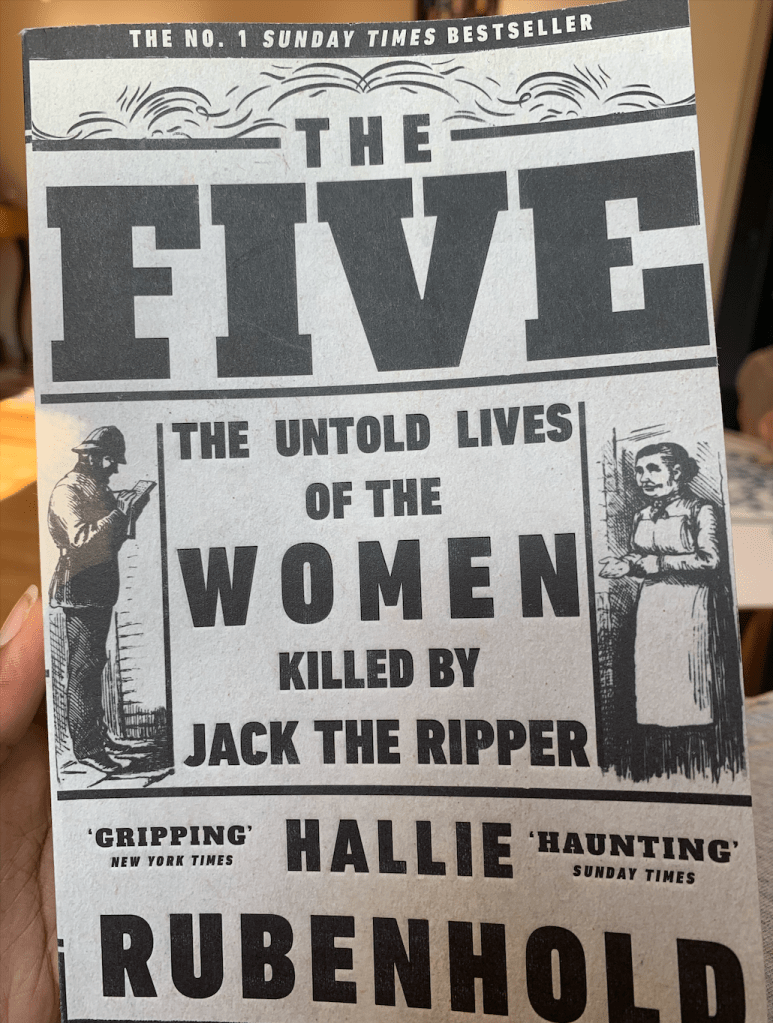
The Five: Untold Lives of The Women Killed by Jack the Ripper. By Hallie Rubenhold

After being sent a plethora of Waterstones subscription emails (haven’t got the heart to unsubscribe), I came across ‘The Five: Untold Lives of The Women Killed by Jack the Ripper’. It was a classic case of judging a book by it’s cover, i mean look at it, an actual newspaperesque front page!

More importantly, however, is the whole purpose of the book in which to give the infamous murder’s female victims a voice, previously ignored due to also being victims of a patriarchal society. Commonly referred to as simply, ‘The prostitutes killed by Jack the Ripper’, Rubenhold poignantly writes a biography of the believed victims- Pollie, Annie, Elizabeth, Catherine and Mary-Jane. Her insightful non-fiction narrative was thoroughly well-researched, delicately telling the important life story of each woman. As a mean to avoid previously glorified Jack the Ripper, and rather, provide some justice for his victims, female author and historian uses her feminist values to paint the picture of the Victorian Era, whilst drawing significant contrasts to the modern day.

True Crime is never usually my go-to, however, the purpose behind it and my interest in life during the Victorian Era, caught my eye. Mirroring Dickens’ by plainly illustrating social injustice and it’s impact was another important aspect. The language was accessible, with careful footnotes and great vocabulary to add to my word bank (iPhone notes). Ooh, also with fascinating photographs of the people involved (I looked at before reading, of course).

With so much information and an Inspector Calls type narrative, I will continue to recommend to anyone looking for a truly good book.

Movie quote: “Life moves pretty fast. If you don’t stop and look around once in a while, you could miss it.” -Ferris Bueller, Ferris Bureller’s Day Off. Iconic 80s film, needed during lockdown as a reminder to make the most of everyday, albeit small (I don’t recommend driving to Chicago town).