

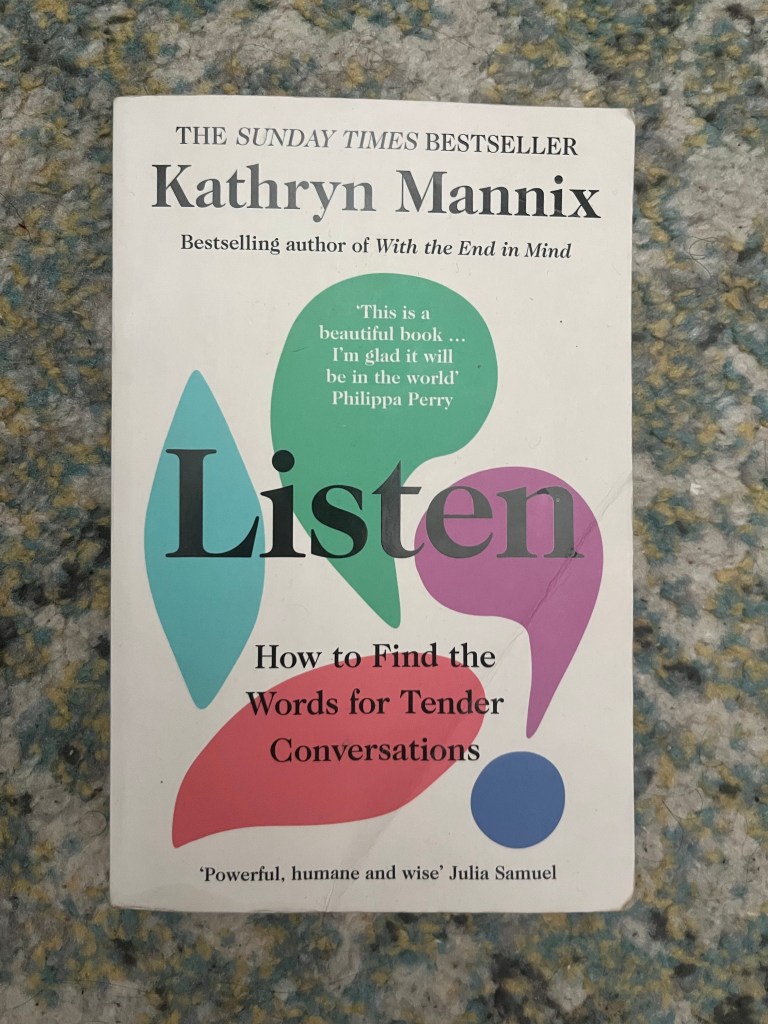
I stumbled across this one after listening to the Word of Mouth podcast by one of my favourite authors Michael Rosen and his guest Kathryn Mannix. Have a listen if you’re into finding out random facts about words at https://www.bbc.co.uk/programmes/m0013hrc She was on the podcast to discuss her latest book, a guide to supporting others going through difficult or challenging times. Mannix captivatingly told the story of her early days as a trainee doctor, having to complete the sensitive task of telling someone their husband had died. She followed the academic steps, did all the right things yet it led to her being hit across the face! From this, she has developed a more humane approach to tender conversions which we all can seamlessly adopt.
I’d like to think I’m a good listener but even I’m no stranger to butting in with unhelpful comments like “at least it’s not x” or “don’t worry” when someone has entrusted me with a probelm. Mannix explains that it’s in our human nature to innocently attempt to make things better, to fill silences and try to help by relating their situation to a similar experience. Although these can work for some conversations and certain individuals, there are more simple and effective strategies. Truly listening! Simply acknowledging their feelings, naming how it makes you feel to be opened up to, retelling what they have said in your own words and the power of delicate touch.
What I love most is Mannix’s choice of genre. It’s a combination of a memoir, self-help book with aspects of fiction. There are characters going through relatable experiences ranging from illness, grief, sexuality, money concerns and disagreements in public situations, this is a mean to explore a plethora of strategies managing conversations in a variety of contexts. Many of these situations are inevitable, so why not be prepared for them?
It’s mostly conversational, the fictional aspects are written beautifully as she sets the scene and it’s not at all patronising. Some of the suggestions can appear unrealistic, such as “I’m open to a discussion but let’s eat first as I won’t be able to focus”. Imagine telling someone they have to wait to open up because you’re hungry!
I’ll admit it’s another one of my niche books, however judging by the reviews by an eclectic audience, she’s done very well. Based on the content of unfortunate situations, it is a difficult book to read when not in the mood. I often read it on the commute to and from work but i couldn’t always read it after a tricky teaching day. I’d recommend it as a holiday book surrounded in a happy environment to read in one go!






 Amber Reads something