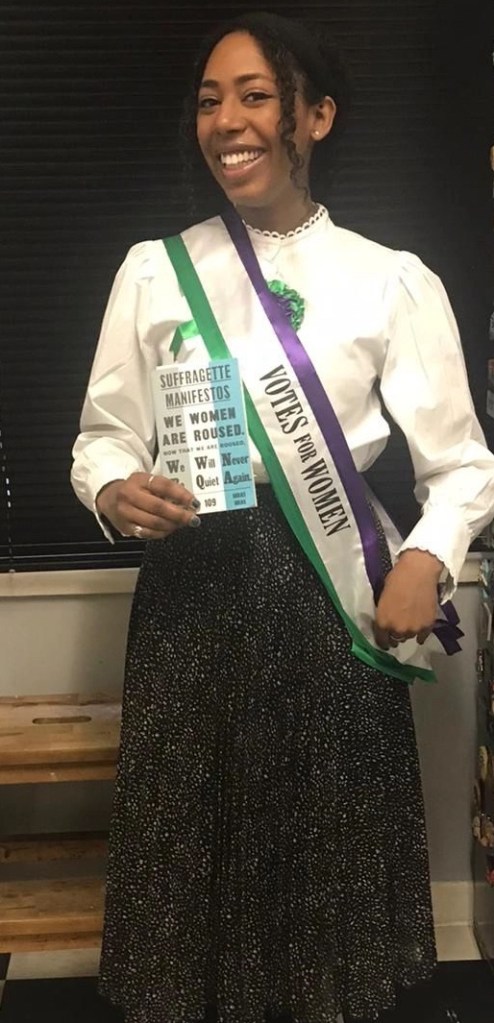
Ok so it’s not strictly primary school related or a fun, fictional read for Workd Book Day, but enlightening my class on inspiring women such as Emmelinre Pankhurst (last year) was a worthwhile decision. Our school has a “bedtime read” theme this year, so pyjamas it is.
Let’s be honest, this was an incentive to become a teacher. I look forward to the annual opportunity to celebrate the power of books and support the charity aiming to improve social mobility through reading. Designed by UNESCO, they ensure every child owns a book of their own to make reading a habit thus increasing children’s life chances. It is marked in over 100 countries around the globe.
Now to the book review; Penguin released a twenty book collection entitled “Great Ideas” to celebrate the work of radical, prodigious thinkers. They have striking covers, which caught my eye (a classic case of judging a book by its cover!). The Penguin Suffragette Manifesto is a collection of documentation during the iconic “Votes for women” campaign fighting for the right to vote in the U.K in the 19th and 20th century. It’s a slim book, with a traditional typeface made up of speeches to pamphlets from notable suffragettes such as Emmiline Pankhurst.
What I loved most was the range of writers and speakers including union workers, actresses, mill workers and aristocrats. The broad range of text makes each new piece a thought-provoking experience. It was hard to read at times based upon the injustice of how women were treated and the language based on the time written. The power of words is rife throughout the text as they passionately encouraged men and women around the country for support.
Next on my reading list is more books on the Suffragists which were more peaceful in their protests, however I am in awe of the dedication of the suffragettes’ forms of protests including hunger strikes, throwing bricks at parliament and countless demonstrations. There is still a long way to go in terms of gender equality in the U.K. and across the globe. I recommend the film Suffragettes as an insightful portrayal of the movement. I read the Big People, Little Dreams children’s book about Emmeline Pankhurst which is more child friendly and a lighter read. Overall I’d give it a 5/5 because how could I not?!
As you may have noticed, I can become rather obsessed and fixated on books I thoroughly enjoy (see my second post on A Clockwork Orange). So much so that I reread, purchase multiple copies, watch any films and in this case, even see a West End play!
My review below will contain teeny spoilers from the novel, theatre production and the second book “Go Set a Watchman”. I don’t usually like to do as I think the best cultural experiences are when you go in relatively open minded. Nonetheless, let’s begin with Harper Lee’s novel.
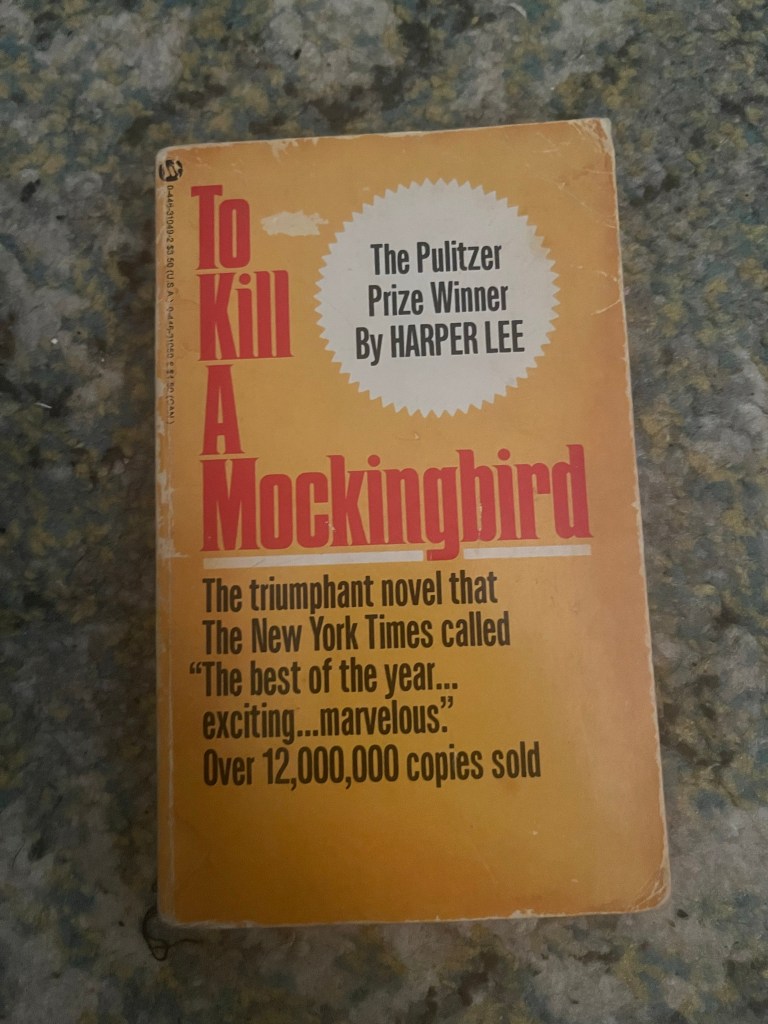
A rightful modern classic brimming with poignant themes of moral justice, class and race written in 1960. It is most definitely worth the hype due to her exploring topics which would have been taboo at the time including gender inequality, addiction and the concept of othering. Despite its heavy themes, the novel gained instant popularity which deservingly continues to this day.
The story is loosely based on her own experiences as a ten year old child in Alabama, much like her protagonist Scout Finch. A confident tom-boy dressed in overalls, extremely close to her older brother, Jem, we observe their tumultuous childhood in a small fabricated town of Maycomb, Alabama, over the course of three years. Almost feeling like a fly on the wall, readers observe how Scout, Jem and eventually their friend Dill, become exposed to the harshness of life through witnessing the lives of their vivid, complex neighbours and harsh impact of their father’s multifaceted rape trial case. Despite the abhorrent racial injustice, alcholism, drug abuse and murder, it is the character of Atticus Finch that reminds readers of morality in difficult situations. He is the epitome of goodness which many admire and aspire to be in the novel and in reality! The novel itself can be split in half; the first of which is the children’s fascination with the mystery of their infamous neighbour Boo Radley. The children re-enact his intriguing life story as they play and the other is the exceptional court case in which Atticus defends a black man on trial for raping a white young woman. It’s a read that tugs on your heartstrings whilst being unable to put down (I literally walked to work with book in hand!). I haven’t read anything so insightful, gripping and powerful in an exceedingly long time.
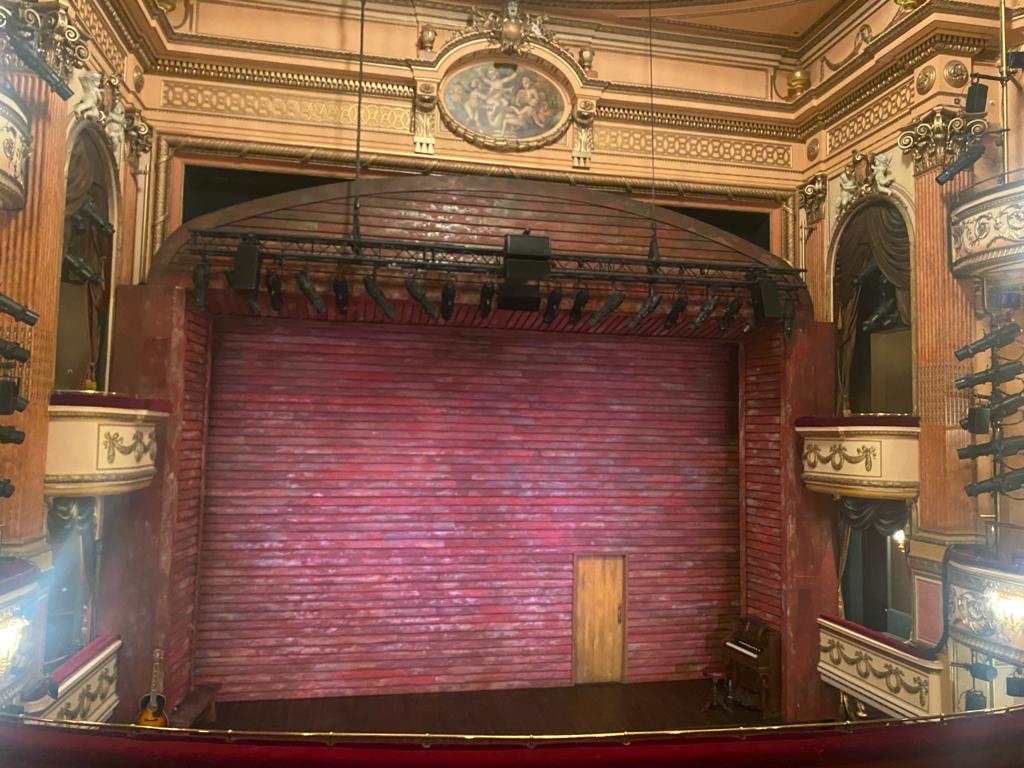
Gielgud theatre, London.
Having been unable to stop talking about how good the book is, my friend read it herself and then we ventured to the theatre! Thanks to Rush Tickets on ‘Todaystix’ the tickets were cheap and in such good seats. The stage itself was simple (as shown above), which became a mini Maycomb as actors brought on moveable sets based on the many locations in the novel. From the Finch household’s front porch, the impressive court case with racial segregation and their neighbour’s houses, each set helped to bring the book alive. We were initially taken aback by the change in narrative order, however they focussed on the ending, ‘How did Bob Ewell stab himself?” Then recreating the novel through flashbacks.
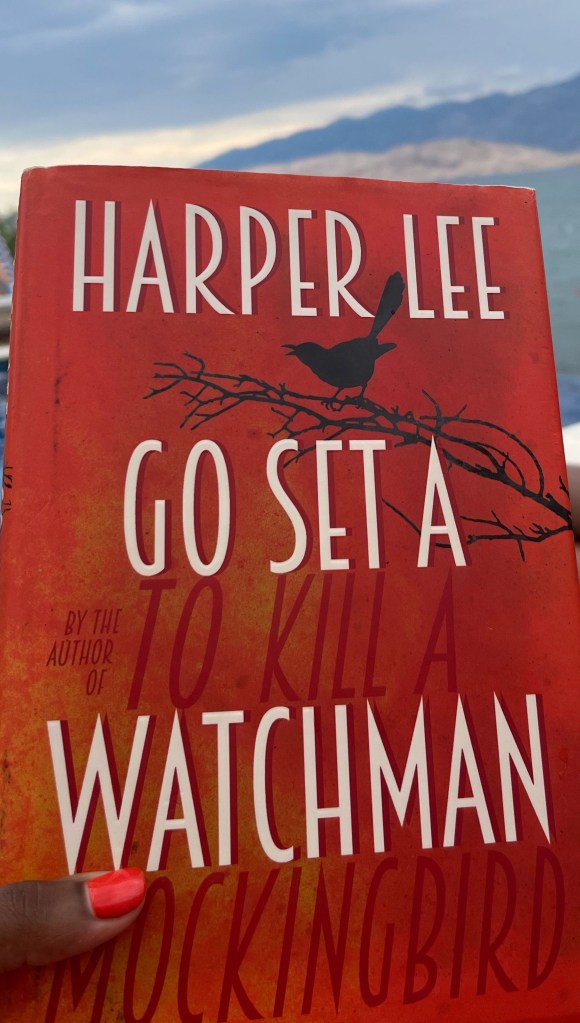
Reading by the pool
Despite by obsession with all things To Kill a Mockingbird, this sequel however was not welcome. I must admit I only read the first few chapters or so but there were too many changes, I refused to persevere. Number 1. Jem had died. Why on earth would she kill him off? Ok, fine it does make a nice plot twist to book readers since it’s set twenty years after the first. But since having a very close brother, I found this too heartbreaking. Number 2. Atticus is a racist. It’s absolutely absurd that he’d become a racist in his old age as it completely taints the themes in the original. Despite my opinions, there is a plethora of media controversies surrounding its release since it was published sixty years after the first, whereby critics believe Lee wasn’t in the right state to be agreeing to legal formalities that come with publishing. In addition, Go Set a Watchman was supposedly written before To Kill a Mockingbird and Lee’s publisher seemingly encouraged her to set the story through the eyes off child Scout. This can’t be the case as the second book is filled with references to the first. It’s got a lovely front cover, I’ll give it that! The concept of adult Scout returning to Maycomb with her mature perspective and the contention surround civil rights movement does make an intriguing plot. It’s unfortunate those changes make such an impact for me to continue. Let me know your thoughts if you persevered!
Whether you read the second book, watch the West End play (which ends in London this May 2023!) or most definitely read the novel, it will be worth it. Harper Lee’s novel is timeless and 100% worth the read.
Reading Natives at the Wellcome Collection Library.
I was brought up encouraged ‘not to see race’. What comes to mind when you hear this? Such discussion came to light when my English friend and colleague recommended Natives: Race and class in the ruins of empire (hereafter referred to as Natives) to me. She was provided with a copy during her university’s ‘Big Read’, which purposefully chose a thought-provoking book to spark discussions regarding race among staff and pupils. She and I did exactly this; we explored the ignorance behind such common phrases and determined how absurd it was of us to dismiss the complexities of race in a passing comment. Our conversation was a mere fragment of Akala’s masterful, stimulating book. As a popular Hip-Hop Artist, author and social entrepreneur, most recently included in the 100 Most Influential Black British People list, he uses his platform as an active speaker to discuss diversity and inclusion in a wide range of settings. In Natives, he eloquently highlights the impact of inextricably linked race and class through an autobiographical lens, supported by a plethora of historical, socio-economic and political sources from the 1980s to present day (notably published in 2019, prior to the 2020 BLM protests). From being infamously ‘Stopped and Searched’, witnessing murder and enduring racism from teachers all before he was sixteen, Akala leaves no stone unturned by outlining the British Empire’s scandals influencing all aspects of his life.
It’s impossible to list all of the controversial topics covered in Natives. He carefully begins with his childhood in 1980s multi-cultural Camden, drawing readers in with his innocent, naiive perception of life as a mixed-race boy loving martial arts and gifted in Mathematics. This idyllic view of life is imminently shattered when name-called for being mixed race in primary school. From here, he explores the origins of racial bias, issues in education, miseducation of slavery, Windrush Generation, gang culture, the impact of music, the KKK and Britain’s involvement in South African apartheid to name a few. By relaying statistics, reports and quotes from influential leaders, Akala encourages the reader to make their own opinions based on facts. I like how he acknowledges that this tells the story of only one Black Brit, despite the countless multifaceted experiences of others, including myself. This emphasises the importance of education and having seemingly difficult conversations. Well, by reading this book, it’ll make anyone question their role in society.
It is a purposefully heavy book, one that did impact me greatly when reading since it reminded me of the doom and gloom of the world! Although, it is an important read and so gripping I finished it in two days (subtle brag!). Despite the tons of references, the autobiographical nature meant that he makes some interesting remarks particularly regarding American politics and even Brexit, but it sparked me to consider my beliefs and want to challenge him! Akala uses rich vocabulary and many ‘woke’ terms but he explains them well and avoids using them in a tokenistic way which so many newly published books on race seem to include. My other favourite aspect is his celebration of his mixed race culture. From his exhilarating visits to his Mum’s side of the family in Scotland crossing Stinky Bridge eating haggis to his memories growing up London influenced by his Caribbean family calling everyone ‘aunty’ and ‘uncle’. It was comforting to hear the beauty of a range of cultures shaping him as an individual, which was reminiscent of my own childhood.
If you are in a book rut, have nothing to read, want to feel passionate or want to be educated on Black British history…read it! 5/5
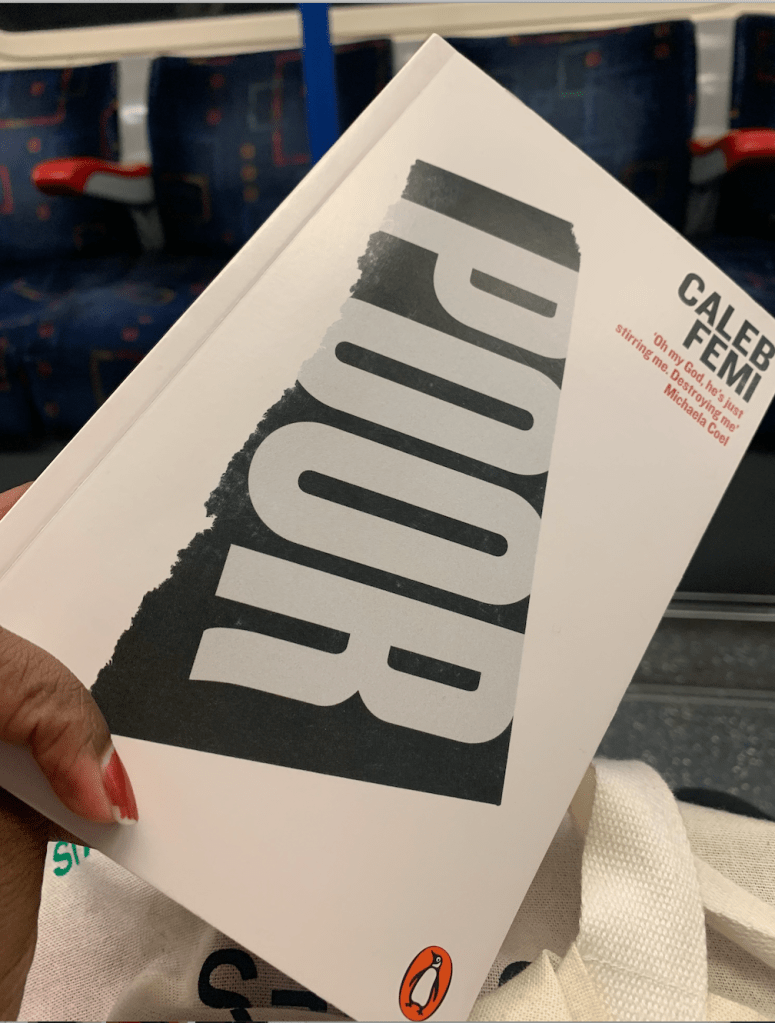
A stunning, remarkable combination of original poetry, photography and extracts regarding the genuine lives of the poor, black youth in Peckham Estate (South London, UK). Femi truly captures the roughness and reality of modern London; whilst delicately exposing the social inequalities which have amounted, as a result of hapless social housing estates.
I’d come across this book after my obsession with ‘Don’t Hate the Playaz’ on ITV hub (a riveting talkshow/gameshow with guests from the RNB music industry) hosted by Rizzle Kick’s Jordan Stephens, who posted this book on his instagram. As a speaker for toxic masculinity, representing black positive culture and of course, the music industry, I immediately ordered the book based on his interest. Wow, I was not disappointed! As you may have realised, I adore classic novels and literature, therefore was utterly enlightened to be transported into the vivid world of poetry, photography and unique narratives.
Each page or two speaks volumes. You can feel Femi’s focus, passion and energy to meticulously select words throughout. My personal favourite page consists of a playscript type structure, in which a Council Estate Designer denotes his decision to build with concrete in one line, immediately beneath this idea is juxtaposed with a council estate inhabitant who describes the loneliness and suffocating feeling of being surrounded by concrete. It’s astonishing how those opposing conversations mirror social inequality. Here, we have this wealthy Conservative architect from the 1960s wanting a quick-fix for the post-war housing crisis, right next to the twenty-first century innocent boy, struggling to find a way out of the poverty cycle. That was only one example of Femi’s intricate work that makes up this book.
There was also a personal aspect to this novel. I grew up in a housing association London flat, grew up in poverty and as a black young woman, have experienced a plethora of hardships. However, I had a wonderful childhood full of diversity, morals and love. Femi also captures the beauty in humanity which comes with poverty, such as the iconic, cultural home cooked meals and infamous South-London accent ‘bruv, money-up’ which takes me back to my beloved inner-London comprehensive school days! I could see and relate to aspects of these stories, without being patronising or judgemental.
Femi has given the South-London youth a voice through a variety of mediums within this book. I can’t persuade you enough to pick up a copy, it’s incredible.


 Amber Reads something