

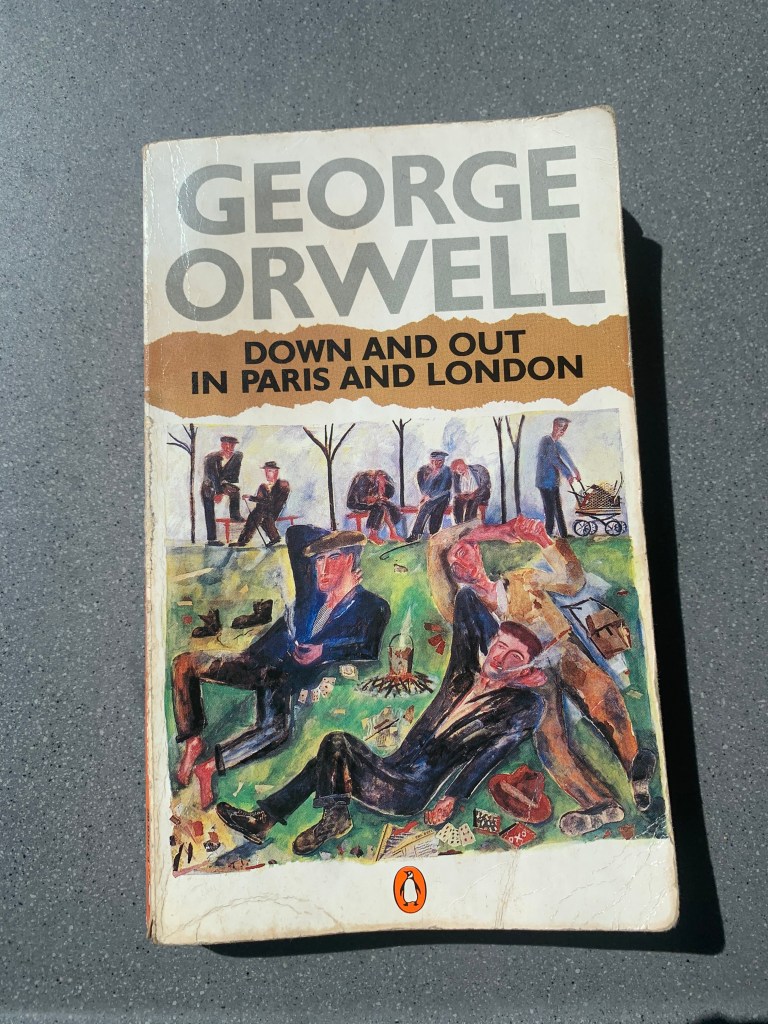
After a charity shop book haul, I was eager to begin this one due to having ultimate faith in trusted author, George Orwell (aka Eric Blair). More famously known for his final book “Nineteen Eighty-four” written before he passed away of TB, “Down and Out in Paris and London” (DOPL) was in fact his first full book. With a strong purpose in which to provide an insight into the world of poverty and unemployment during the early 20th Century in two prosperous cities- Paris and London.
Aspects of the book were based on Orwell’s observations during his own experiences of being “down and out” in both cities. Despite his affluent upbringing and prestigious education at Eton College, Orwell did not wish to conform to his peers and progress into Oxbridge. Instead, he served in the army and then decided to live in Paris as a writer. This did not bode well and he, like many other educated people as vividly described in the book, became a “plongeur”, essentially a dish washer in ostentatious Parisian hotels. The first half of the book explicitly comments on the experiences of an Englishman becoming a plongeur in Paris, with extreme detail on how he survives on hardly any francs, wine and stale bread. Meeting interesting characters along the way, including his Russian friend “Boris” who he ends up lodging with in a room covered with bugs. Orwell does not shy away from the appalling conditions of those working eighteen hours a day in a sweltering underground kitchen, earning just enough for a single meal before repeating their monotonous day once again. He likens the life of a plongeur to a slave, commenting on the absurdity of the wealthy who dine in such hotels, who’s incredulous demands fuel such maltreatment of staff.
The second half comments on the vast unemployment in London which could possibly be the cause of the “tramp culture” in London. In comparison to the educated scholars who became lost to the Parisian system, the protagonist meets uneducated, hapless men in London who seem to have given up and instead plan their days around collecting cigarette ends and succumb to praying in a church for vile tea and a slice of toast. Again, Orwell intensely describes the odours of such characters and their experiences in numerous homeless shelters, known as “spikes”. He comments on the way such places strip men and women of any dignity they may have left, however aptly describes the unfortunate as victims to our society.
Nearly one hundred years on and the same social issues are prevalent today. A book written for the middle and upper classes to empathise and highlight the real lives of those among them can be applied today. Another social-economic read similar to “The Five” (see first post) however from a male narrative with a mixture of fiction and non-fiction. I must admit, it took me a little while to read as I had to keep rereading the page if I got lost! So was a tad difficult to follow, however once I allocated the time to read and remained focused it could be done well!
Film quote-
“Roads? Where we’re going, we don’t need roads!” Doc Brown, Back to the Future.
My favourite film ever! I hope that the future will be rid of stark social inequalities, that society would have listened to one another to build a safe, prosperous and equal life for all. I hope that in 30 years the world will look entirely different..for the best.
 Amber Reads something